
Resilient AI & Multimodal Data Analytics for Rail Systems
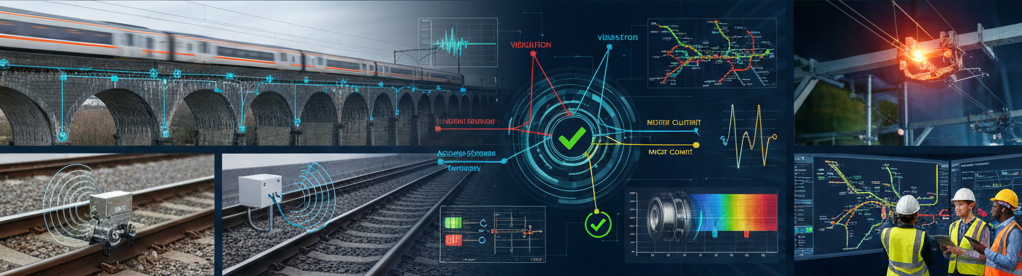
Multimodal Decision Intelligence for Rail Infrastructure
Modern rail networks are moving beyond reactive repairs toward a “Resilient AI” framework. By synthesising foundational data from diverse sensors, we enable an infrastructure that predicts failures before they disrupt.
The challenge for modern rail is not a lack of data, but a lack of Causal Certainty. Current monitoring systems operate in silos, leading to high false-alert rates and “Ghost Maintenance.”
Our Resilient AI platform integrates disparate physical domains—vibration, acoustics, and electrical signatures—to provide a synchronised Ground Truth. We move the network from reactive monitoring to Prescriptive Asset Management.
Our Solution: Private, Enterprise-Grade Foundational AI
EngScience designs and deploys Private Foundational AI Models—Enterprise-scale solutions specifically trained on your company’s unique, confidential data assets.
We eliminate the data leakage risk by delivering a secure, proprietary model that operates entirely within your environment, ensuring your intellectual property remains exclusively your competitive advantage.
1. Vehicle-Track Interaction (VTI) & Liability Attribution
The Engineering Challenge: Axle Box Acceleration (ABA) alerts are frequently triggered by track-geometry anomalies (switches, rail squats, or dipped joints) rather than rolling stock defects.
The Multimodal Solution: We correlate Onboard ABA with Wayside Rail Vibration and GPS-tagged Infrastructure Geometry data.
The Diagnostic: The AI performs real-time “Noise Cancellation” by comparing vehicle vibration against the wayside baseline. If the onboard spike is unique to the vehicle, it is a Wheel/Bearing Fault. If both sensors spike, it is a Track Geometry Defect.
The Business Outcome: Instant settlement of maintenance liability between Infrastructure Manager and Train Operator, eliminating “unattributed” delay minutes and unnecessary fleet withdrawals.
2. Acoustic Emission (AE) & Sub-Surface Bearing Diagnostics
The Engineering Challenge: Conventional wayside microphones are susceptible to aerodynamic noise at speed, and vibration sensors often detect bearing failure only after significant spalling has occurred.
The Multimodal Solution: We leverage Wayside Acoustic Beamforming arrays coupled with Surface-Mounted Ultrasonic AE (Acoustic Emission) specifications.
The Diagnostic: Unlike air-coupled sound, Ultrasonic AE captures the high-frequency elastic waves generated by micro-cracking and lubrication film breakdown. By correlating internal AE energy with the external wayside acoustic signature, we detect “Stage 1” bearing fatigue.
The Business Outcome: Extends asset life-cycles by identifying defects weeks before they manifest as thermal “Hot Boxes,” allowing for maintenance during scheduled windows rather than emergency line closures.
3. Traction Motor Current Signature Analysis (MCSA)
The Engineering Challenge: Mechanical resistance from a seized bearing or gearbox failure is often masked by variations in train load and gradient-driven torque requirements.
The Multimodal Solution: Integration of Three-Phase Motor Current with Real-Time Load Weight and Inertial Measurement (IMU) data.
The Diagnostic: The AI utilizes MCSA to isolate “Harmonic Sidebands” indicative of mechanical drag. By normalising this against GPS-verified inclines and load-weight data, the system identifies “Motor Strain” that is independent of operational demands.
The Business Outcome: Prevention of catastrophic drivetrain seizure and reduction in energy consumption by identifying “Hidden Drag” across the fleet.
4. Infrastructure Resilience: Smart Bridges & Catenary Dynamics
The Engineering Challenge: Aging masonry and metallic structures require 24/7 monitoring, while overhead lines face “Dewirement” risks due to thermal expansion and pantograph oscillations.
Structural Integrity: AI-driven analysis of bridge dynamics using strain-gauge and accelerometer data to monitor the health of legacy structures without manual possession.
Pantograph-Catenary Interface: Real-time correlation of Thermal IR imagery and Vertical Force measurements to identify “hard spots” in the overhead line, preventing wire pulls during extreme temperature events.
The Multimodal Advantage: Eliminating the “Cost of Guessing”
Detection Mode | Standard RCM | Our Multimodal AI | Decision Confidence |
Bearing Health | Vibration Thresholds | AE + MCSA + Acoustics | Triple Validated |
Track Roughness | Manual/Visual | ABA + Wayside Vibration | Automated Localisation |
Wheel Flats | Impact Detectors | Acoustics + ABA Correlation | Eliminates Track-Induced Noise |
Catenary Wear | Periodic Inspection | Vision + Thermal + Force | Predictive Wire-Pull Prevention |
Our AI-Driven Methodology: for Precision
Our proprietary methodology is the fusion of cutting-edge artificial intelligence,and powered by engscience’s foundational research.
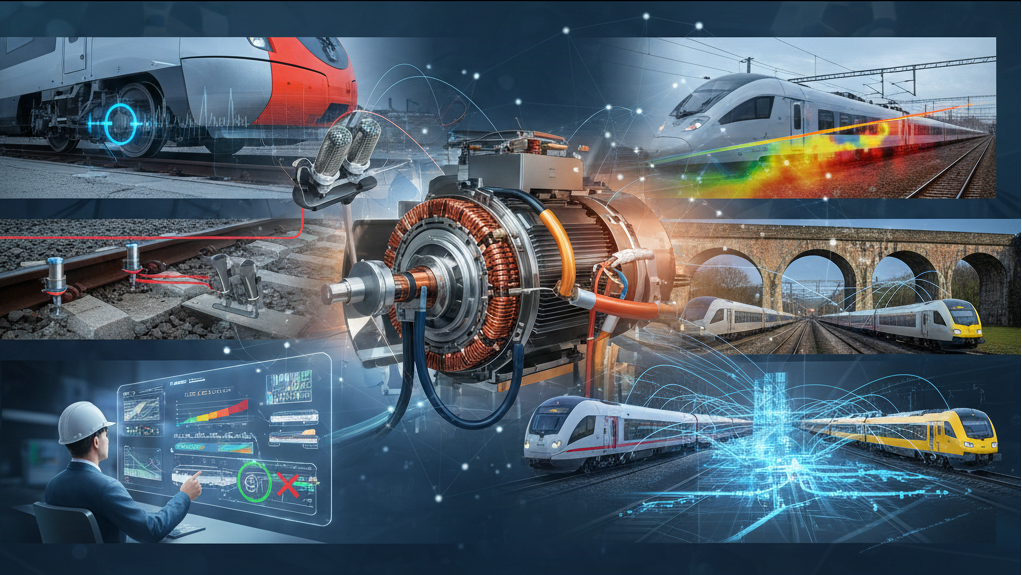
Why Foundational Data Matters
Without clean, synchronised foundational data, AI is just guesswork. By locking the synchronisation of GPS, time-stamping, and multimodal sensor input, we create a “Digital Twin” of the rail corridor that grows smarter with every passing ton of freight.
Resilient AI for Rail Systems
Engineering Methodology: Data Sovereignty & Sensor Agnostic Intelligence
We do not sell proprietary hardware. We provide the Intelligence Framework.
We offer comprehensive Minimum Functional Specifications (MFS) for sensor deployment, ensuring that your hardware procurement meets the high-fidelity requirements of advanced AI. Our platform is designed to ingest raw data from approved industrial suppliers, converting it into Causal Decision Intelligence.
Partner with us to transform your “Big Data” into “Certain Action.”
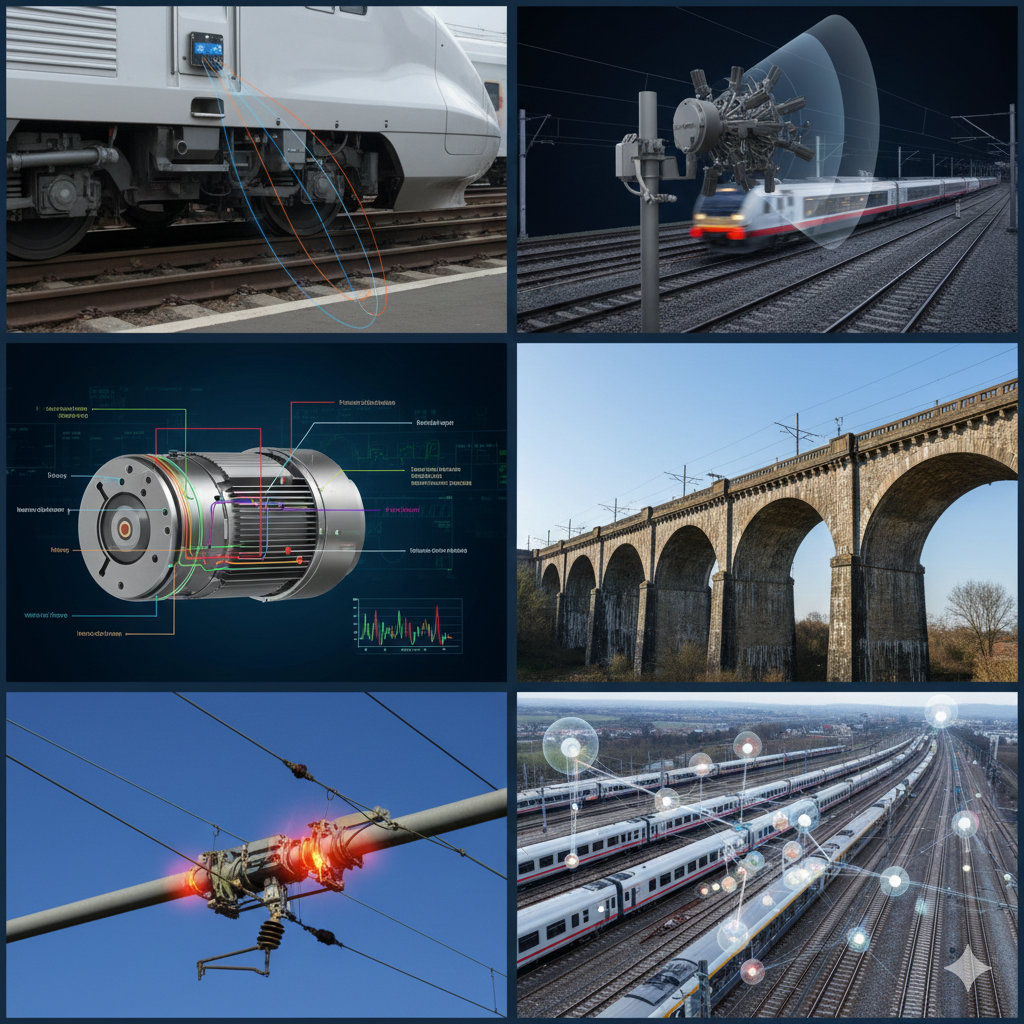
Supporting the Safety Case: Human-in-the-Loop Intelligence
The adoption of AI in safety-critical rail environments requires a rigorous Safety Case and compliance with established industry standards. Our Resilient AI is designed not to replace the expert engineer, but to empower them. By providing a verifiable Evidence Base for maintenance decisions, the platform supports safety sign-offs with multi-modal proof. This ensures that every intervention is backed by correlated data, reducing the subjective risk in asset integrity assessments.
We believe that the most robust AI solutions are built through deep industry collaboration. Our Multimodal Research & Development Program is designed to bridge the gap between raw sensor data and operational certainty.
Strategic R&D Partnerships
We are currently inviting Infrastructure Managers and Rolling Stock Owners to join our 2026 Pilot Program. This initiative focuses on validating our Correlation AI within real-world operational environments.
Integrated Data Validation: We work with partners to ingest existing data streams (Acoustic, ABA, and GPS) to benchmark current fault-detection accuracy.
Targeted Sensor Deployment: Based on our Gap Analysis, we provide technical specifications for supplemental high-fidelity sensing (MCSA, AE, and IR) to eliminate remaining “blind spots” in asset health.
Safety Case Development: We collaborate with your safety teams to ensure our AI outputs provide the rigorous documentation required for industry-standard risk assessments and sign-offs.
From Snapshot to Heartbeat: Continuous In-Service Monitoring
Traditional infrastructure monitoring relies on specialised Measurement Trains that provide periodic snapshots of network health—often weeks or months apart. Our framework shifts the paradigm to In-Service Monitoring. By utilising the existing passenger and freight fleet as a continuous sensor array, we provide a Daily Heartbeat of the network. This high-frequency data allows for the detection of “rapid-growth” faults that periodic measurement trains might miss, ensuring infrastructure resilience between scheduled inspections.
Collaborative Innovation: Shaping the Future of Rail Resilience
Pathways to Implementation: Funded Pilots & Feasibility
We recognize that transitioning to a Resilient AI framework requires rigorous validation. We engage with industry partners through structured Proof of Concept (PoC) phases designed to prove ROI without disrupting active operations.
Structured 3–6 Month “Deep Dive” Studies
These studies are designed to validate the precision of multimodal correlation on specific high-traffic or high-risk corridors. Our primary focus is the reduction of “unattributed” delay minutes and the elimination of false-positive maintenance triggers.