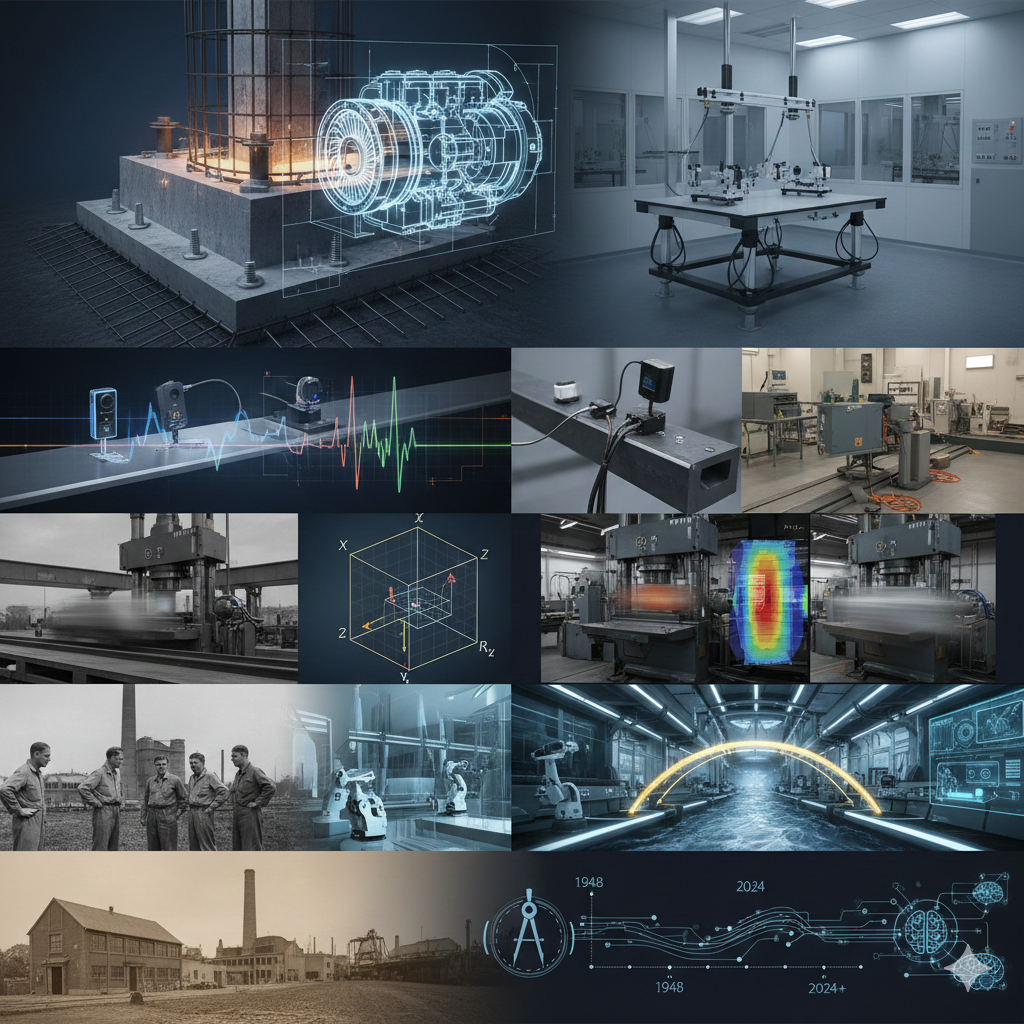
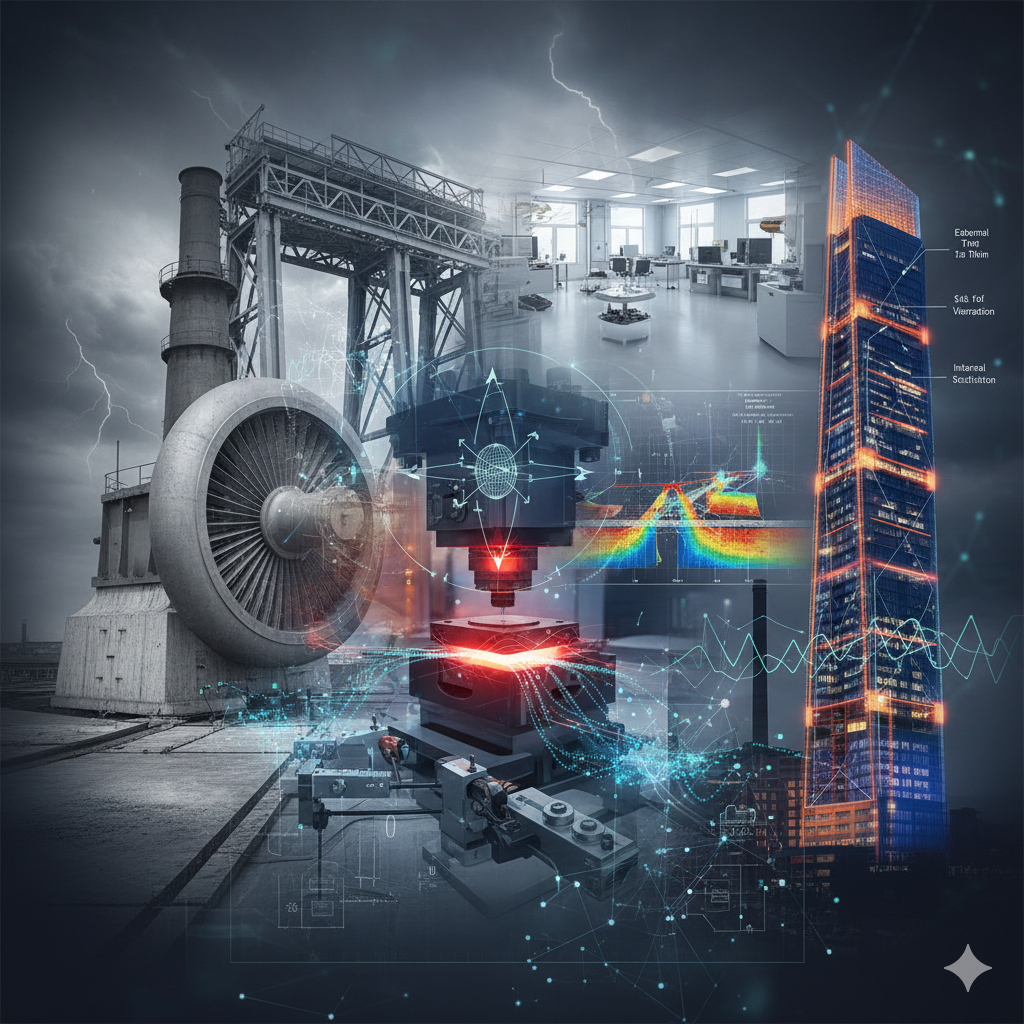
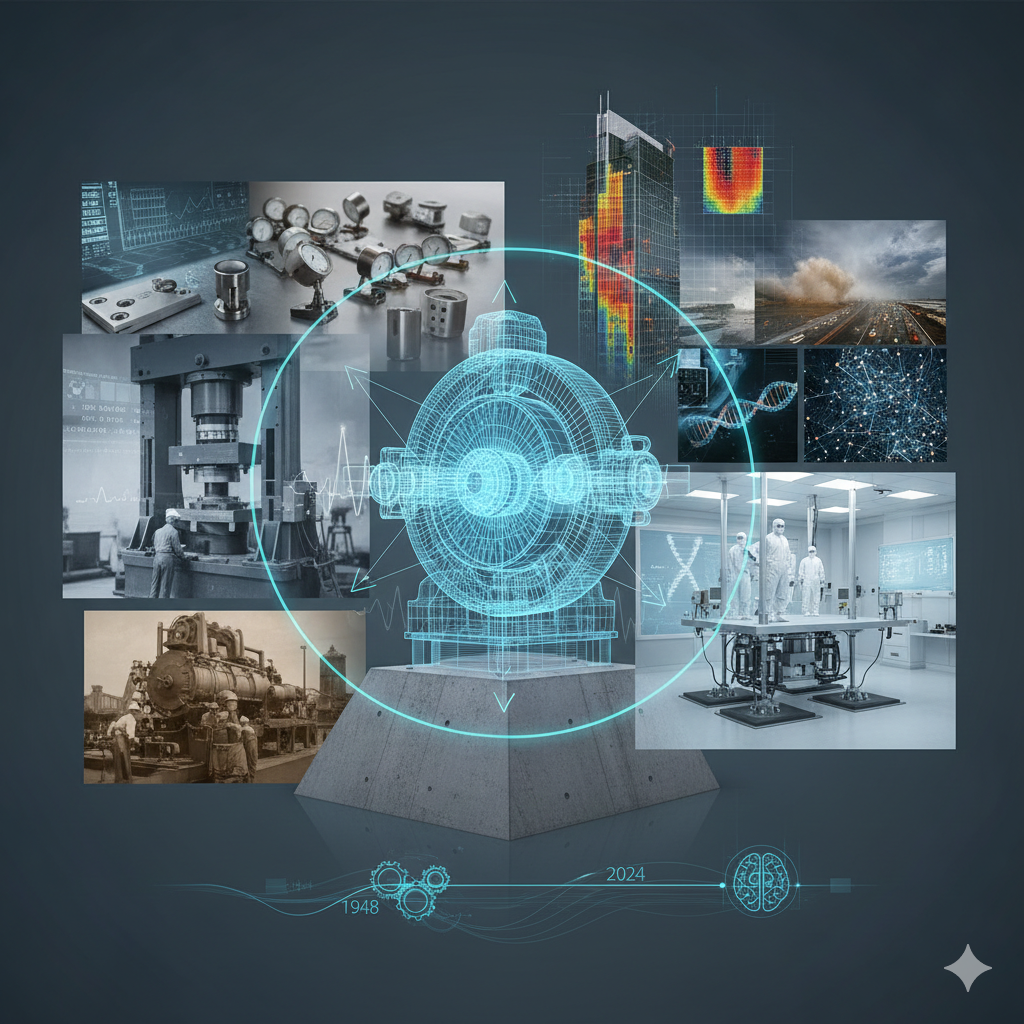
Since 1948, Engineering Dynamics (EngScience) has been at the forefront of mitigating risk in complex mechanical and structural systems. Our expertise lies at the intersection of physical measurement and predictive modeling, ensuring that high-performance structures remain stable under the most demanding conditions.
We specialize in the dual challenge of dynamic design:
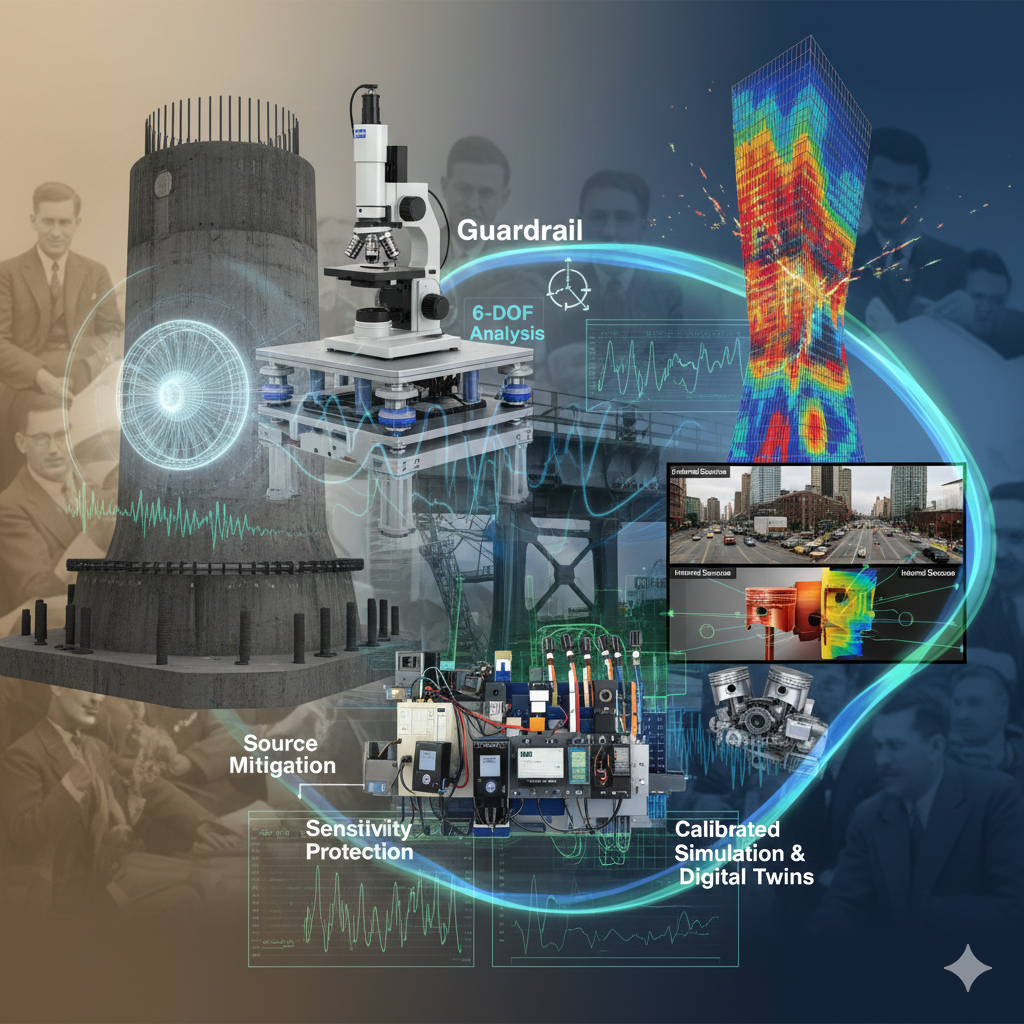
Source Mitigation: Designing robust foundations for heavy machinery that generate significant dynamic loads (e.g., turbines, presses, and reciprocating engines).
Sensitivity Protection: Engineering superstructures for high-precision equipment that are ultra-sensitive to ambient ground vibrations or acoustic disturbances.
2. Precision Measurement & Quantification
Our simulation accuracy is rooted in real-world data. We utilize high-fidelity sensors to quantify displacement, velocity, and acceleration.
Empirical Baseline: We don’t rely solely on theoretical models; we measure existing environments to establish an accurate baseline for “dynamic noise.”
6-DOF Analysis: We analyze movement across all six degrees of freedom to ensure no hidden resonances compromise the system.
3. Calibrated Simulation & Digital Twins
We use finite element analysis (FEA) and multi-body dynamics to simulate how structures will respond to stress.
Model Calibration: By comparing simulation results with physical measurement data, we calibrate our models to reflect real-world behavior with extreme precision.
Predictive Response: This allows us to simulate the response of structures to both internal sources (vibrations from within the machine) and external sources (seismic activity, traffic, or adjacent industrial operations).
Advancing Technology
To Design with Ai
The EngScience Advantage: “Stability by Design”
The hallmark of our approach is the reduction of uncertainty. Whether it is a heritage industrial site or a modern laboratory environment, we provide the “Guardrails” necessary for equipment to operate at peak performance. Our legacy in Engineering Dynamics ensures that every simulation we run is backed by nearly eight decades of empirical knowledge.
We specialize in the dual challenge of dynamic design:
Source Mitigation: Designing robust foundations for heavy machinery that generate significant dynamic loads (e.g., turbines, presses, and reciprocating engines).
Sensitivity Protection: Engineering superstructures for high-precision equipment that are ultra-sensitive to ambient ground vibrations or acoustic disturbances.
2. Precision Measurement & Quantification
Our simulation accuracy is rooted in real-world data. We utilize high-fidelity sensors to quantify displacement, velocity, and acceleration.
Empirical Baseline: We don’t rely solely on theoretical models; we measure existing environments to establish an accurate baseline for “dynamic noise.”
6-DOF Analysis: We analyze movement across all six degrees of freedom to ensure no hidden resonances compromise the system.
3. Calibrated Simulation & Digital Twins
We use finite element analysis (FEA) and multi-body dynamics to simulate how structures will respond to stress.
Model Calibration: By comparing simulation results with physical measurement data, we calibrate our models to reflect real-world behavior with extreme precision.
Predictive Response: This allows us to simulate the response of structures to both internal sources (vibrations from within the machine) and external sources (seismic activity, traffic, or adjacent industrial operations).
1. Foundation & Superstructure Engineering
We specialize in the dual challenge of dynamic design:
Source Mitigation: Designing robust foundations for heavy machinery that generate significant dynamic loads (e.g., turbines, presses, and reciprocating engines).
Sensitivity Protection: Engineering superstructures for high-precision equipment that are ultra-sensitive to ambient ground vibrations or acoustic disturbances.
2. Precision Measurement & Quantification
Our simulation accuracy is rooted in real-world data. We utilize high-fidelity sensors to quantify displacement, velocity, and acceleration.
Empirical Baseline: We don’t rely solely on theoretical models; we measure existing environments to establish an accurate baseline for “dynamic noise.”
6-DOF Analysis: We analyze movement across all six degrees of freedom to ensure no hidden resonances compromise the system.
3. Calibrated Simulation & Digital Twins
We use finite element analysis (FEA) and multi-body dynamics to simulate how structures will respond to stress.
Model Calibration: By comparing simulation results with physical measurement data, we calibrate our models to reflect real-world behavior with extreme precision.
Predictive Response: This allows us to simulate the response of structures to both internal sources (vibrations from within the machine) and external sources (seismic activity, traffic, or adjacent industrial operations).
Subscribe & get 20% off on your first project,
Be with us