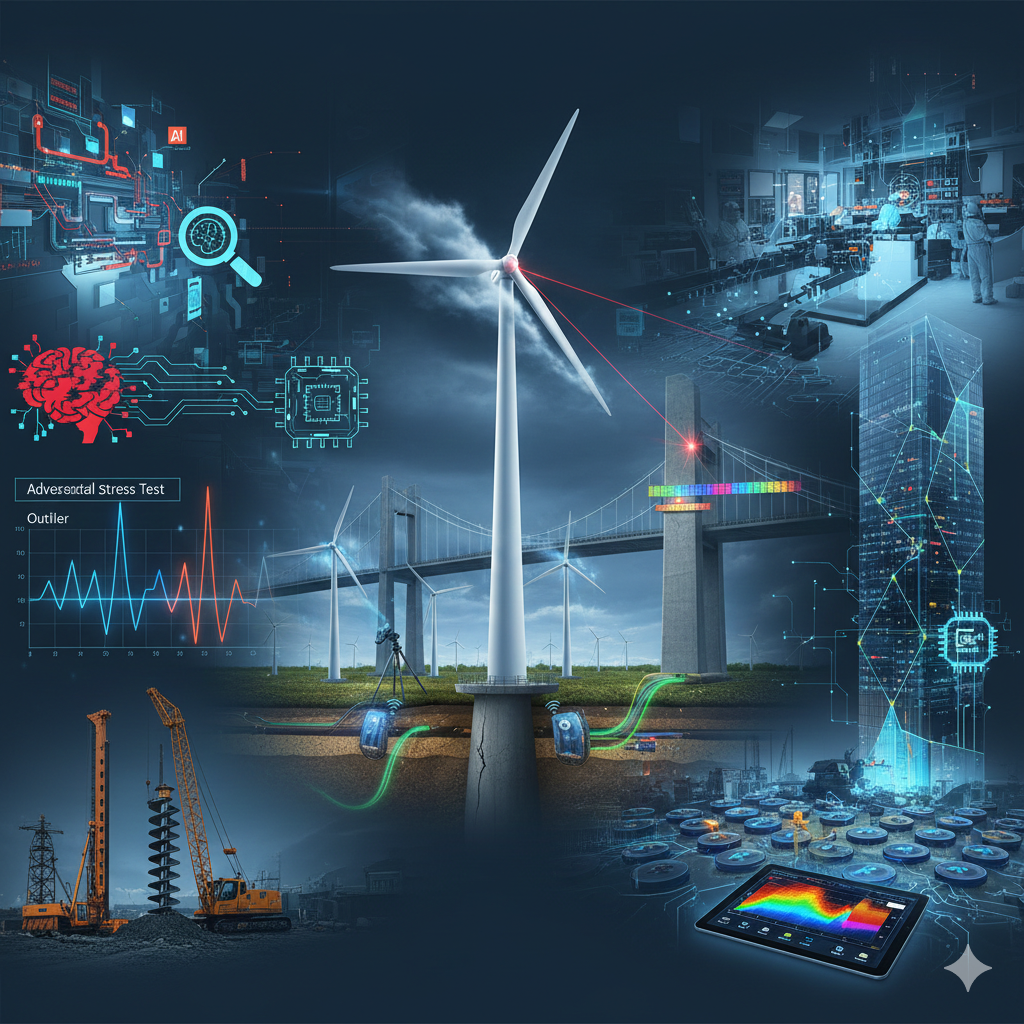
off-the-shelf sensors often fall short and lack the sensitivity, resolution and frequency response to capture the true energy flux of a system.
EngScience designs and sources systems that meet demanding specifications needed for accurate and reliable quantification of energy flux and structural response.
Reach out with your requirements and let us set out the performance metrics and monitoring strategies required to protect your high-value assets.
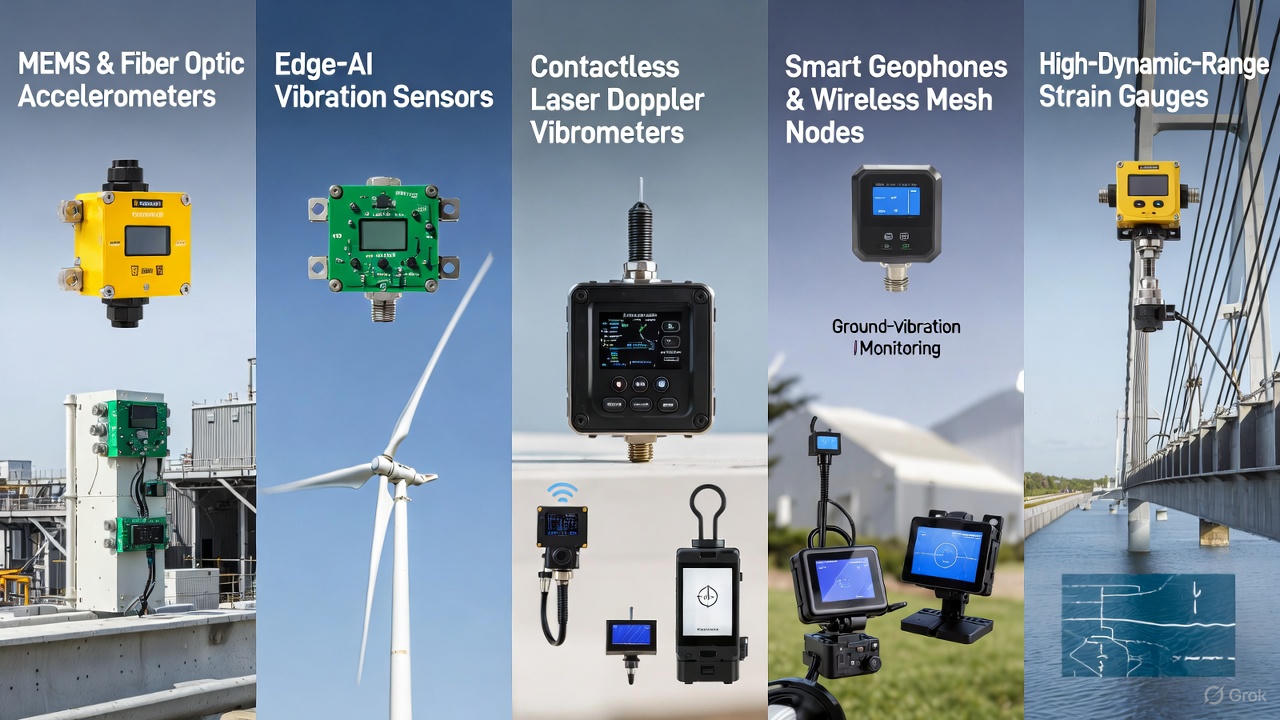
1. MEMS & Fiber Optic Accelerometers (Seismic Grade)
Traditional sensors are being replaced by high-sensitivity Micro-Electro-Mechanical Systems (MEMS) and Fiber Bragg Grating (FBG) sensors.
They are immune to electromagnetic interference (EMI), which is critical for Silicon Fabs and Data Centres where massive electrical loads can “pollute” standard sensor data.
Application: Long-term structural health monitoring and sub-micro-vibration detection in labs.
2. Edge-AI Vibration Sensors
Demand has shifted from “dumb” sensors that just stream data to “smart” nodes that process FFT (Fast Fourier Transform) analytics on-site.
They reduce the bandwidth needed to monitor large-scale assets. Instead of sending raw noise, they only send “alerts” when a specific vibration signature deviates from the baseline.
Application: Condition monitoring for wind turbines and industrial rotating machinery.
3. Contactless Laser Doppler Vibrometers (LDV)
As “Systems Engineering” looks at harder-to-reach or dangerous assets, contactless sensing is peaking.
They allow for the measurement of high-frequency vibration without adding “mass loading” (the weight of the sensor itself) which can change the frequency of very small or sensitive components.
Application: Testing aerospace components and high-speed silicon manufacturing arms.
4. Smart Geophones & Wireless Mesh Nodes
In Ground Dynamics, the trend is moving toward rapidly deployable wireless “dense arrays.”
Setting out miles of cables is slow and expensive. Wireless nodes that self-organize into a mesh allow engineers to map the “energy flux” of an entire construction site or city block in real-time.
Application: Forensic ground-vibration monitoring during urban piling or tunnel boring.
5. High-Dynamic-Range (HDR) Strain Gauges
New capacitive and optical strain sensors that can handle both the tiny vibrations of ambient noise and the massive shocks of seismic events or structural failure.
To provide the “Integrity” you mentioned—having sensors that don’t “clip” or fail when the structural loads get intense.
Application: Bridge monitoring and skyscraper wind-load verification.